Sunday, 27 July 2014

Research should start by determining the research issue rather than the choice of research method

A lot of the postgraduate students that I met were focusing on the choice of research method rather that one research issue (unsolved problem) that is worth solving within a preset time frame. 

Postgraduate students should have determined the research issue in the domain of study first, formulating the hypotheses (quantitative approach) or hypothetical propositions (qualitative approach) based on initial literature review, before choosing a research method or a combination of several methods that they believe can answer the research question. 

For doctoral research student, this process may take 3 to 9 months, in which the students would establish an epistemological paradigm that affords the creation of new knowledge--an essential element that qualifies the award of PhD or DPhil. 

Dilemma faced by Western educational researchers

Western educational researchers generally regard experimental studies as "unethical" now. 

I see this as a result of the debate between Chomsky and Skinner: conducting experiments on human beings is like treating human beings as animals. However, probably due to this ethical consideration in the Western academia, I hardly see ground breaking educational research outputs conducted in Western countries nowadays, as compared to early and middle of the 20th century. 

Having said so, I participated in several experimental studies conducted under the Psychological Department when I was studying in University of Warwick. In other words, Experimental studies are allowable under the domain of psychological studies, but not educational studies in certain universities. 

In UPSI, my colleagues in Sports Science also conduct experimental studies that involve blood test--as long as they follow ethical protocol set by the university and the Sports Council. So whether you can conduct experiment studies or not depends on which department or domain of study you are studying your PhD.  

Choosing a PhD supervisor

It is indeed a difficult matter to determine who should be your supervisor in the doctoral journey. Once you are awarded the doctorate degree, academics would normally ask "who is your supervisor" instead of "which university you receive your PhD". Although the actual supervision would be around three years, but the implication of the relationship is lifelong.

Herewith a good guide for those who are pursuing or intend to pursue a PhD:

Saturday, 12 April 2014

Asking questions

Herewith my notes when I was learning how to design question:

Classification questions

  • Name, sex, age, status, etc = basis for analyzing associations between variables
  • Add in “it will help us in further analysis if you would tell us a little about yourself”.
  • Don’t get info that is not needed, e.g. exact age (use range instead); salary (use job grade instead).

Question contents (validity)

Questionnaire needs to cover the research issues that have been specified.
  1.       I must be clear about the information required and encode this accurately into a question.
  2.        The respondent must interpret the question in a way I intended.
  3.        The respondent must construct an answer that contains information that I have requested
  4.        I must interpret the answer as the respondent had intended it to be interpreted.

Questions to ask when designing questions:

  1.           Is the question necessary? Just how will it be useful?
  2.           Are several questions needed on the subject matter of this question?
  3.           Do respondents have the information necessary to answer the question?
  4.           Does the question need to be more concrete, specific and closely related to the respondent’s personal exposure?
  5.           Is the question content sufficiently general and free from spurious concreteness and specificity?
  6.           Is the question content biased and loaded in one direction, without accompanying questions to balance the emphasis?
  7.           Will the respondents give the information that is asked for?

Drafting the answer

  • Decide on how you want people to respond and stick with it. Tick (/), underline, circle. DON’T mix.


Notes on Social Constructionism (2009)

A major focus of social constructionism is to uncover the ways in which individual and groups participate in the creation of their perceived reality.
It involves looking at the ways social phenomena (how games are perceived and how games engage players) are created, institutionalized (in game studios?) and made into tradition by humans (game designers; in creative industry).
Socially constructed reality is seen as an ongoing, dynamic process; (why? As ICT evolves rapidly or change of players’ need / demand—linear to interaction; traditional media to new media)
Reality is reproduced (games are redesigned / upgraded / re-packaged); by people acting on their interpretation and their knowledge of it.
Berger and Luckmann (1967) argue that knowledge is derived from and maintained by social interaction:
“When people interact, they do so with the understanding that their respective perceptions of reality are related, and as they act upon this understanding their common knowledge of reality becomes reinforced. Since this common sense knowledge is negotiated by people, human typifications, significations and institutions come to be presented as part of an objective reality. It is in this sense that it can be said that reality is socially constructed.
Ian Hacking (1999): The Social Construction of What?
Berger and Luckmann (1967): The Social Construction of Reality: A Treatise in the Sociology of Knowledge
Theoretical perspective is the philosophical stance lying behind a methodology: it provides a context for the process involved and a basis for its logic and its criteria.
Assumptions I made when I choose a particular methodology.
Interpretivism looks for culturally derived and historically situated interpretations of social life world.
Max Weber (1864 – 1920)
Human Sciences
Natural Sciences
Understanding
Causality
Interpretive approach
Explicative approach (explaining)
Qualitative research methods
Both the natural sciences and social sciences may be concerned at any given time with either the nomothetic or the idiographic.
The one scientific method should apply to these 2 forms of sciences and should cater for both nomothetic and idiographic inquiry
-------
Wilhelm Dilthey (1833 – 1933):
-          Social reality and natural reality are different kinds of reality, therefore their investigation requires different methods.
Windelband and Richkert:
-          Rejecting the notion that there is some kind of real distinction between natural reality and social reality.
-          Accept that there is a logical distinction
o   In the case of nature, science is looking for
§  Consistencies
§  Regularities
§  The ‘law’ that obtains nomothetic generalizing method.
o   In the case of human affairs (in historical studies), we are concerned with the individual case idiographic individualizing method.
§  Isolate individual phenomena in order to trace their unique development
ASSUMPTIONS: symbolic interactionism (Blumer, 1969, p2)
-          Human beings (game developers) act toward things on the basis of the meanings that these things have for them;
-          The meaning of such things is derived from, and arises out of, the social interaction that one has with one’s fellows (seniors, other experts, etc);

-          These meanings are handled in and modified through, an interpretive process used by the person in dealing with the things he encounters (various game genres).

Wednesday, 14 August 2013

如何读一本书

我跟同事借了一本书《如何阅读一本书》。我是用朗读的方式阅读的,以便日后如果有须要可以听自己的声音作温习:

第一篇:阅读的层次

第一章:阅读的活力与艺术

主动是阅读

阅读的目标:为获得资讯而读,以及为求得理解而读

阅读就是学习:指导型的学习,以及自我发现型的学习之间的差异

老师的出席与缺席

第二章:阅读的层次

第三章:阅读的第一层次:基础阅读

学习阅读的阶段

阅读的阶段与层次

更高层次的阅读与高等教育

阅读与民主教育的理念

第四章:阅读的第二层次:检视阅读

检视阅读一:有系统的略读或粗读
1. 先看书名页,然后如果有序就先看序。
2. 研究目录页,对这本书的基本架构做概括性的理解。
3. 如果书中附有索引,也要检阅一下。
4. 如果那是本包着书衣的新书,不妨读一下出版者的介绍。
5. 从你对一本书的目录很概略,甚至有点模糊的印象当中,开始挑几个看来跟主题息息相关的篇章来看。
6. 把书打开来,东翻翻西翻翻,念个一、两段,有时候连续读几页,但不要太多。

检视阅读二:粗浅的阅读

阅读的速度

逗留与倒退

理解的问题

检视阅读的摘要

Tuesday, 13 August 2013

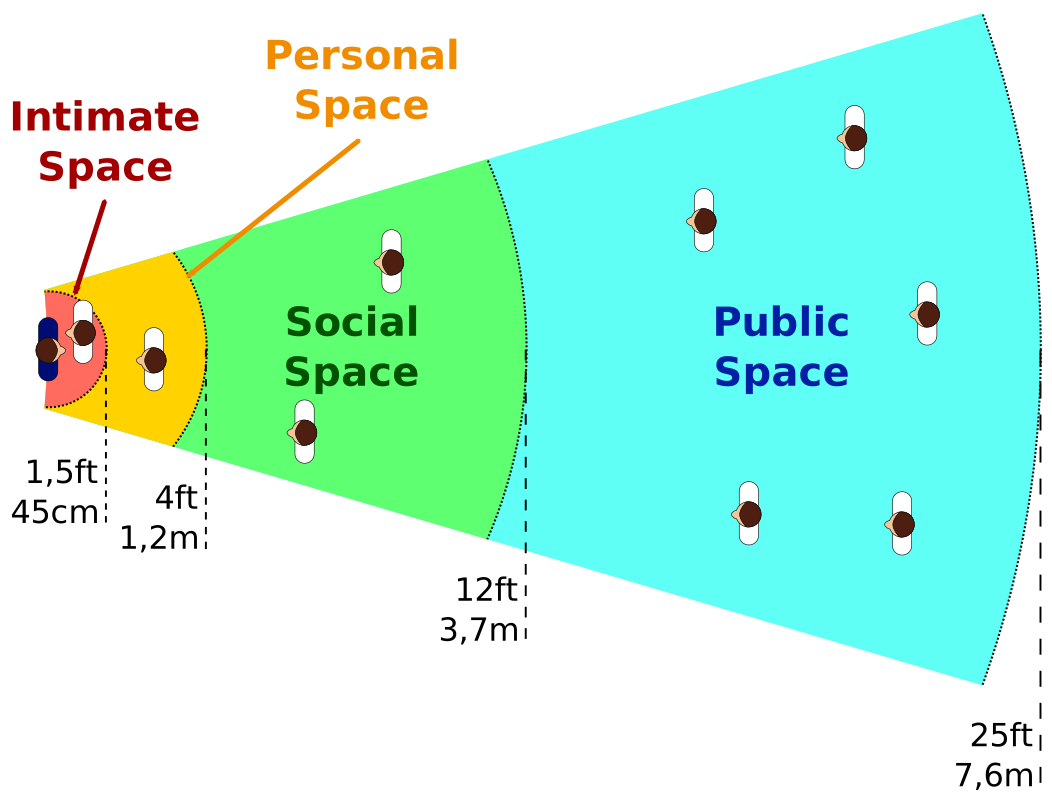
Proxemics 人际距离学

I learned a new concept today: proxemics. 
I found this concept very interesting, as it is related to my lecture on "Effective Presentation". 
Edward T. Hall (1966)
Intimate space (0m) independent self space.
Personal space (0.15m - 0.45m) distance from lover, parents, children, pet.
Social space (1.2m - 2.1m) suitable for business and social interaction
Public space (3.7m - 7.6m) suitable for public speaking.


Source: Jean-Louis Grall posted in Wikipedia